


Andrea Poros, a lecturer in the Department of Foreign Languages and Literature at ELTE TÓK, also participated in the creation of the virtual exhibition, which was created to mark the 100th anniversary of Ellen Key’s death. The creators’ goal is to raise awareness of the life and work of the Swedish writer, educational thinker, and social reformer.
The Faculty of Primary and Pre-School Education at Eötvös Loránd University and the Ellen Key International Research Network (EKIR) organized a three-part international conference series to mark the 100th anniversary of the author’s death; the first stop took place in Stockholm in October 2025, the second in March 2026 in Budapest, and the third in October 2026 in Bologna.
The Swedish author’s progressive views on education, women’s rights, and sociocultural reforms left a lasting mark on 20th-century thought. As a pioneer, she contributed to the development of feminism, child-centered education, and social reforms. As one of the defining voices of the “Modern Breakthrough” (Det moderna genombrottet) era, she advocated for the individual, empathy, and the transformative power of art, love, spirituality, and education. In her 1910 work “The Rights of the Child” (Barnabalken), she outlined new principles for children’s rights and well-being. She was also a staunch advocate for women’s right to education. She championed women’s political and civil rights, while also emphasizing the social importance and values of motherhood. Ellen Key’s ideas on education, individualism, and voluntary obedience remain relevant to this day and are the subject of scholarly discourse.
Andrea Poros, a lecturer in the Department of Foreign Languages and Literatures at ELTE TÓK and a researcher on the life of Ellen Key, participated in the closing conference in October with a presentation titled “Devotion, Dialogue, Difference: Ellen Key’s Hungarian Correspondents.” The presentation examined the intellectual and emotional reception of Ellen Key in Hungary through the letters of her Hungarian female and male correspondents from the early 20th century. The research sought to answer how the correspondents related to Ellen Key’s persona and ideas, which of her works they were familiar with, and what differences could be observed in the way female and male letter-writers addressed her, in their emotional expressions, and in their intellectual reflections. The presentation highlighted that private correspondence not only bears witness to the reception of Ellen Key’s ideas in Hungary but also serves as an important arena for the interpretation, reformulation, and international circulation of those ideas.
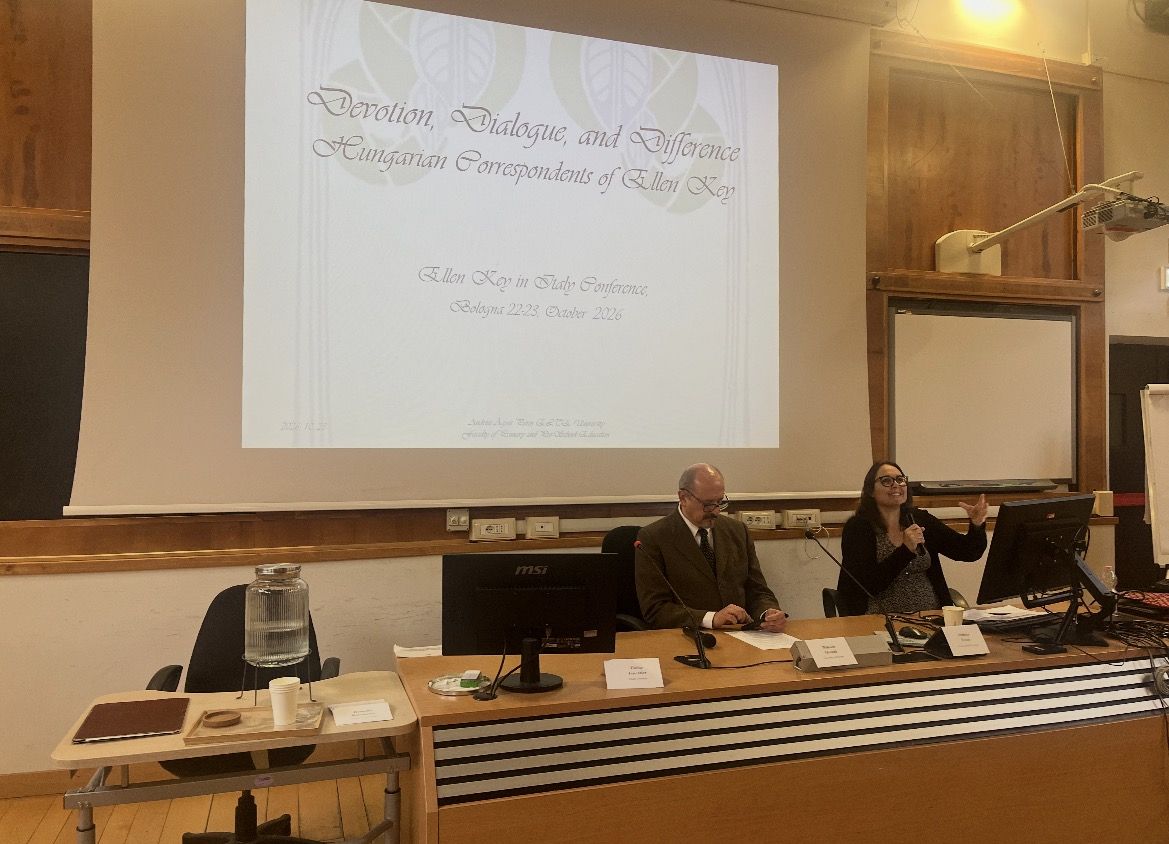
Andrea Poros's presentation in Bologna
Andrea Poros also helped create the virtual exhibition that was unveiled on the occasion of the Bologna conference. The researcher emphasized that she and her fellow creators hope the exhibition will bring Ellen Key’s life and work closer to the public, as her ideas and values continue to influence society and the upbringing of children to this day.
The exhibition can be viewed via the link below.
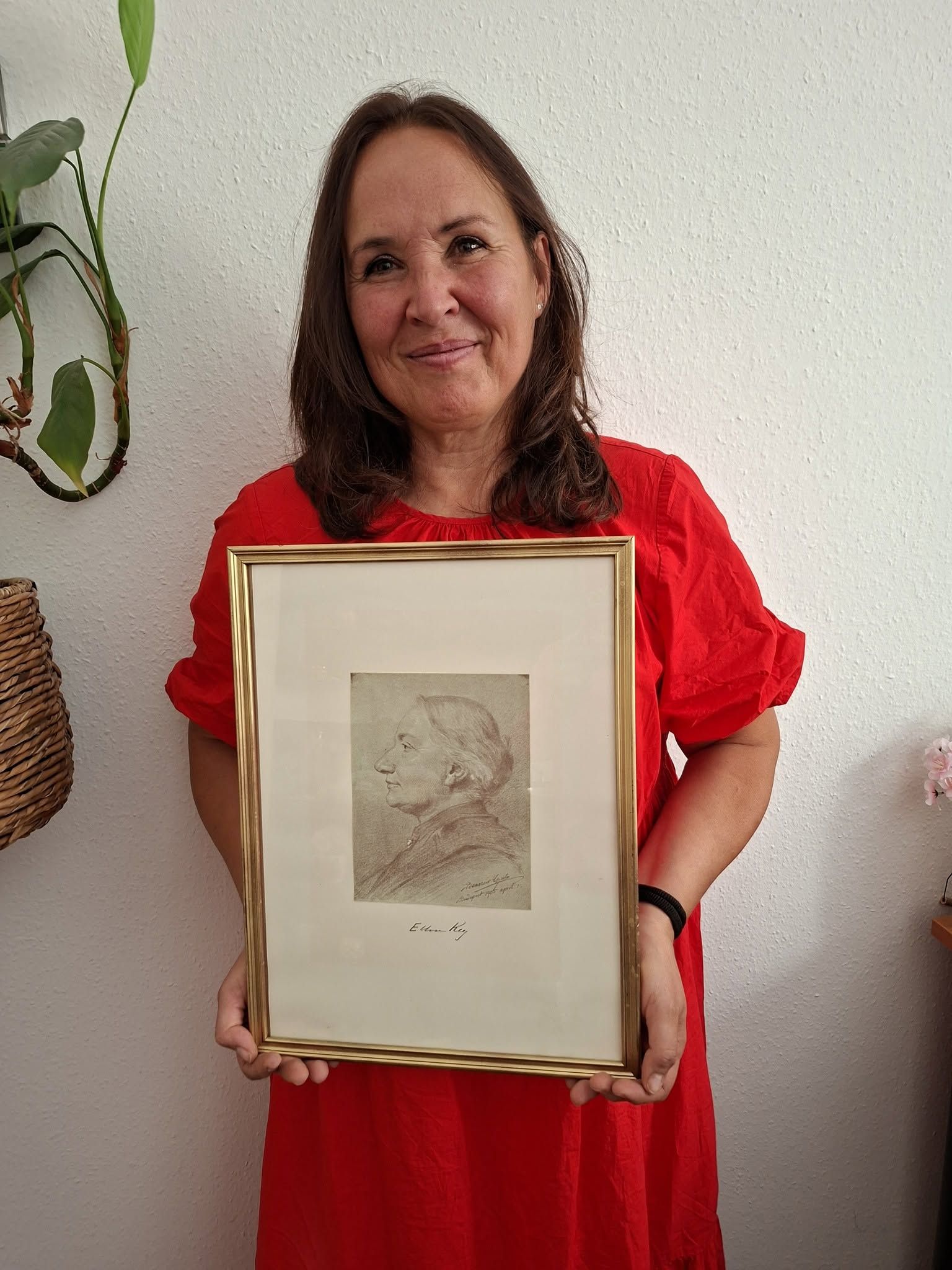
Gyula Benczúr’s Portrait of Ellen Key Returns to Budapest After More Than 120 Years
To mark the 100th anniversary of the writer’s death, a portrait of Ellen Key—painted by Gyula Benczúr on April 1, 1905, of the Swedish writer during her stay in Budapest—has returned to Budapest after 120 years. The sale of reproduced copies of the drawing, signed by Ellen Key, supported a child protection initiative. Now, more than 120 years later, thanks to an initiative by Andrea Poros, two copies of the portrait have returned to Budapest: one to the faculty meeting room at ELTE TÓK, and the other to the Swedish Embassy in Budapest. Thus, in addition to honoring Ellen Key’s legacy, this unique portrait also commemorates more than a century of Hungarian–Swedish cultural ties.